
Dear Berlin

Dear Berlin,
I have always been fascinated by your stories since I started learning German. During all these years, I imagined you by reading books, watching videos, looking at photographs and even listening to songs. For all these years, I pictured you in many ways, primarily unclear and changing occasionally. And when we met for the first time, I lost my heart in your alleys. A blurry face got a precise guise. You told me your memories and anecdotes and I listened to them like a 5-year-old. You amazed me, Berlin. Since then, I felt the need to tell your amazing accounts to everyone. Everyone needs to know, the way you flabbergasted me, with mind-boggling. So here I am telling your adventures .
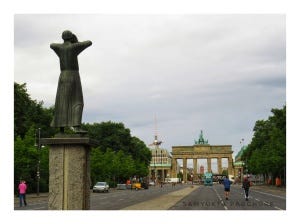
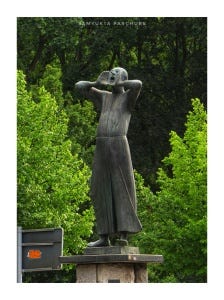
Der Rufer – The Crier
This three-meter bronze sculpture was installed on the celebrated 17 Juni Strasse (17th June Road) in May 1989. This sculpture was designed in 1967 by Berlin-born sculptor Gerhard Marcks (1889-1981) and was established in memory of his centenary birth year. The statue was installed in the western side of the Berlin Wall facing the eastern side. The Crier or Der Rufer, as this statue is known, symbolises the cry for peace which represented the divided German community of the bygone Cold War era. A quote by the Italian poet Francesco Petrarch inscribed on the statue says, “Ich gehe durch die Welt und rufe Friede, Friede Friede” (I wander through the world and cry ‘peace, peace, peace’).
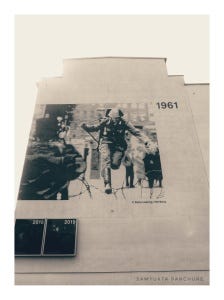
Leap into Freedom
Conrad Schumann, a 19-year-old East German soldier, jumped over the rolled barbed wire at the corner of Bernauer and Ruppiner Strasse (Street). The rolled wire then used to be the division between East and West Germany. This iconic ‘Leap to Freedom’ took place on 15th August 1961 (exactly 62 years ago) when Schumann, a trained shepherd from Saxony, was posted as a guard just near the barbed wire. On 15th August around 4 in the afternoon, he spontaneously decided to act on his prevised plan to flee to the West side. When no one was looking, he pressed down a little bit on the wire and signalled the photographers on the West side about his plan to escape. The photographers kept their cameras ready, a police van was positioned a few meters away from the wire with the back door open. The photographers pointed their cameras towards other border guards (East German soldiers) to move them away from this spot. Grabbing the correct opportunity, Schumann jumped over the wire, the exact moment was captured by Peter Leibing. When the border guards turned, they saw that Schumann was being driven away in a West Berlin police van. He later remained in the refugee centre in West Berlin until September 1961. Later on, the West German government moved him to Bavaria to build a new life for himself. He claimed that he never regretted his decision to jump but it haunted him for his entire life along with the fear of the Stasi Police (East German Secret Police Force). But for unknown reasons, Conrad Schumann committed suicide in the year 1998. After he jumped, the East German government portrayed this event as a kidnapping, but they were unable to maintain this stand because of the widespread media attention in West Germany.
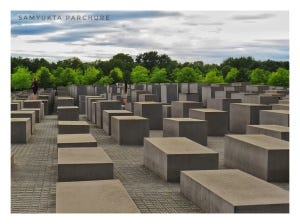
Holocaust Memorial
Established in 1999, this memorial was designed by New York-based architect Peter Eisenman. The memorial consists of 2711 concrete stelae, of different heights covering an area of 19,000 sq meters. The concrete stelae are built on the ground having a wave-like form. This uneven ground and size of stelae give a feeling of being trapped or stuck.
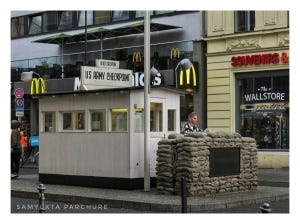
Checkpoint Charlie
Checkpoint Charlie was a wall-crossing point between East and West Berlin during the Cold War. In October 1961, the Soviet and the US combat-ready armies faced each other at this checkpoint for 16 hours before a peaceful understanding was established between the two nations. The name ‘Charlie’ was named after the letter ‘C’ according to NATO’s phonetic alphabets. The picture of a soldier seen today at this checkpoint belongs to the US Army’s tuba player Jeff Harper. He was 22 when his photograph was taken as a part of the series to commemorate the last Allied soldiers in Berlin in the year 1994. This checkpoint witnessed many escape attempts by the East Berliners into West Berlin.
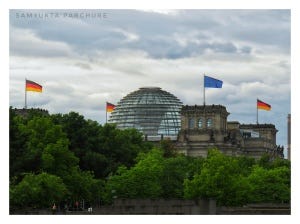
Bundestag
‘Bundestag’ popularly known as ‘Reichstag’ is a German Parliament Building, built in the year 1871 under the era of the German Empire (Second Reich) in Berlin which was then the capital of the Kingdom of Prussia. The current structure was erected two decades later. After the German Revolution 1918-1919 (end of First WW), the Weimar Constitution was established here. The building was damaged in the arson fire attack, by a Dutch communist Marinus van der Lubbe on 27th February 1933. The incident took place just four weeks after the Third Reich was sworn in as the Chancellor of the nation. The building was partially repaired between 1961 to 1964 and later on, it was completely restored from 1995 to 1999.
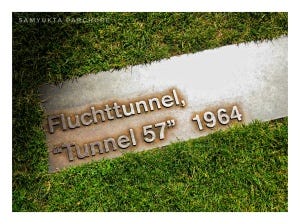
“Tunnel 57”
Built under the Berlin Wall, this tunnel successfully helped 57 people escape, from East Berlin to the West side of the Wall, the only mass escape that happened in the years when the Berlin Wall existed. The incident took place on the 3rd and 4th of October 1964. The tunnel was the longest and deepest tunnel built during the Cold War period in Berlin. It had a starting point in the basement of a bakery at 97 Bernauer Strasse in West Berlin and an endpoint in a disused rear courtyard at 55 Strelitzer Strasse on the eastern side of the wall. The tunnel was approximately 12 meters deep and 145 meters long. The construction of this tunnel started in West Berlin and was initiated by 37 West Berliners including Reinhard Furrer (German astronaut and physicist) and a few students from Freie University of Berlin. The secret construction started in April 1964 and ended in October of the same year. Approximately 120 people planned to escape from this tunnel, but one of them was the Stasi spy (East German Secret Police Force) and thus this secret escape mission was revealed on the second night of fleeing (4th October 1964). After the escape mission was discovered the tunnel was filled up with sand and was sealed forever.
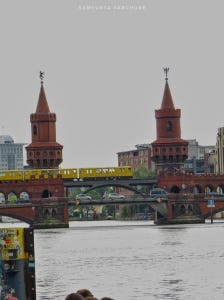
Oberbaumbrücke
Berlin is said to have more bridges than Venice and this bridge is one of them. Built on the River Spree, the bridge is known as the ‘Oberbaum Bridge’. The name translates as Upper Tree Bridge, referring to a large tree trunk spiked with nails and lowered every night. The purpose of this was to prevent anyone from smuggling goods along the river. Although this huge wooden trunk was dismantled in the year 1896, the bridge is still known by its original name. During the Cold War era, the bridge served as an important checkpoint to cross the border between the Friedrishain and Kreuzberg districts.
Berlin Cathedral
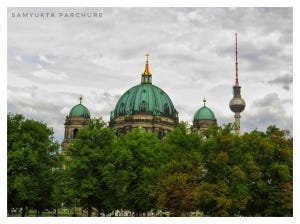
Berlin Cathedral famously known as ‘Berliner Dom’ is the largest Protestant Church in Germany. This church acted as a representative location of the Hohenzollern dynasty (which was later split into two; Catholic Swabian and Protestant Franconian branches). Although the current structure was built between 1894 to 1905 under the reign of Emperor William II, the history of the Dom goes back to the 15th century. The Dom was severely damaged during the years of the 2nd World War. During the Cold War era, it was on the eastern side of Berlin. In 1538, it showcased the Renaissance style of architecture, changing its form to Brick Gothic (1538-1747), Baroque (1747-1817), Neoclassical (1817-1893) and finally in Neo-Renaissance architectural style since 1905.
Berlin Opera
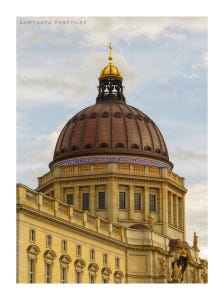
This opera house was built under the reign of the Prussian King Fredrick the Great between 1741 to 1743 in a Palladian style. It was severely damaged during the air bombings of World War II between 1941 to 1945 and was rebuilt from 1951 to 1955. The concerts were relocated to the Admiralpalast and the Schauspiel Haus during the War years. After the war, this opera served as the State Opera for East Germany. In 1955, after rebuilding the original structure, the Opera was once again moved to its original place. However, it remained isolated after 1961 when the capital city and the entire nation were divided.
Schloßbrücke (Palace Bridge)
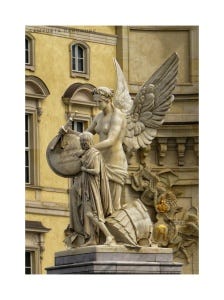
Schloßbrücke (Palace Bridge) existed in central Berlin since the 15th century. Built on one of the canals of River Spree, this bridge narrates stories from Greek mythology. The sculpture in the photo portrays Nike (the one with the shield) instructing the boy. This sculpture was designed by Emil Wolff in the year 1847. In Greek mythology, Nike is the goddess associated with victory in the fields of art, music, war and athletics.
Humblt Brothers – Alexander von Humbolt
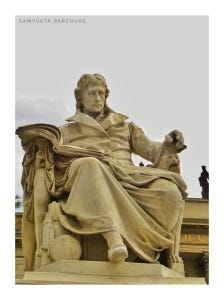
Friedrich Wilhelm Heinrich Alexander von Humbolt (14th September 1769 – 6th May 1859) popularly known as the ‘father of ecology’ and father of environmentalism’ was a German geographer, naturalist and explorer. He was one of the initial people to propose the theory that the countries bordering the Atlantic Ocean were once attached. During his five years travelling in South America, he discovered the Transit of Mercury and the location of the magnetic equator. It’s said that he was the first person to coin the term ‘Permafrost’.
Humbolt Brothers – Wilhelm von Humbolt
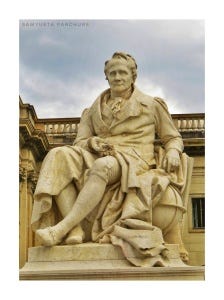
Friedrich Wilhelm Christian Karl Ferdinand von Humbolt (22 June 1767 – 8 April 1835) was a Prussian philosopher and linguist. His major contribution is to the philosophy of languages, ethnolinguistics and learning theory. Along with his brother Alexander von Humbolt, he founded the famous Humboldt University in Berlin. In 1808 he was appointed to the Prussian minister post.
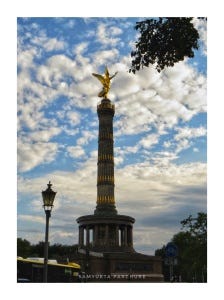
Siegessäule – Victory Tower
Berlin’s ‘Golden Lizzy’ is a Victory Column built to celebrate the Prussian victory in the Second Schleswig War after 1864. The construction of this tower was completed in the year 1873, by which time, Prussia had defeated Austria (Austro-Prussian War) and France (Franco-Prussian War). The golden sculpture on the top of the tower depicts the Roman Goddess Victoria, with a height of 27 feet, designed by Friedrich Drake.
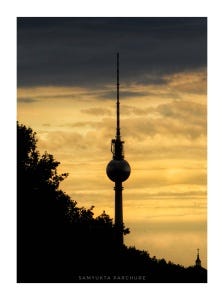
Berlin TV Tower
Constructed between 1965 to 1969 this tower was marked as a symbol of the communist power during the Cold War in Germany. This tower was a mega project of the German Democratic Republic (DDR) in East Germany which was used for broadcasting. The total height of the tower was 365 meters till the end of the 20th century. When a new antenna was installed in the year 1997, the height of the tower rose to 368 meters. It’s the city’s most visible landmark, viewed from any part of the city.
Brandenburger Gate
This neoclassical structure was built on the order of Prussian King Frederik William II. The construction of this gate was to mark the victory over the Dutch unrest. The gate is used to connect the city of Berlin with the town of Brandenburg an der Havel (Brandenburg on the River Havel). It was designed by a Prussian royal architect Carl Gotthard Langhans. The sculpture on the top of this gate, Roman goddess Victoria in a chariot of four horses, was commissioned by Johann Gottfried Schadow. This gate was severely damaged during the 2nd World War and Cold War and was restored shortly after peace was established in the city.
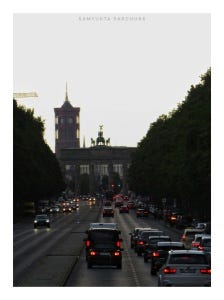
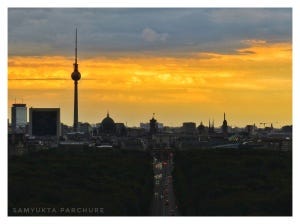
Berlin Skyline
You were beautiful, Berlin
Check out Berlin Guide on our Instagram Page (click here)
Support us on Instagram (click here)